Showing posts with label tourist. Show all posts

Friday, 22 July 2016

New Ross and Dunbrody Famine Ship


New Ross is in County Wexford and is a port that was used during the time of the Great Famine to send emigrants from Ireland to other parts of the world including Canada and the United States. It is my belief that New Ross may also be the same port that my great-great-great-grandfather, John Jackman, came through to board the ship named Ann to sail to Canada to start a new life. I don’t know why he decided to do this but he did.

New Ross has a tourist site that is not usually seen in most Irish ports, a replica of a famine ship. The original ship had the name of Dunbrody and has been replicated well in most respects. I believe that the replica was built in the same shipyard in Quebec as the original ship.


The original ship was built to bring lumber, furs, and other natural resources from Canada to Ireland. As it was going to be sailing back to Canada with no cargo, the Dunbrody was outfitted with bunks and took famine victims with them. The bunks were removable so that they could continue to carry cargo on their way back to Ireland.

There were two types of passengers, passengers who could pay more and have a cabin and passengers who paid less, or whose landlords paid passage for them and looked after their own needs while onboard ship. Once arriving in Quebec, they often had to wait onboard before disembarking at Gross Iles for medical inspections. Most of the emigrant ships did not prepare well for their passengers, some of them running out of fresh drinking water before their turn to disembark their passengers, but the Dunbrody had a couple of captains who were humane and made sure that there was enough water for consumption as well as cleanliness. They had very little loss of passengers and their passengers wrote back to Ireland praising the two captains.


There were also some actors who helped to bring about the vision of what life was like on the famine ship while enroute to Canada. The people portrayed were real people and the program was an interactive presentation. I am sure that I have a better understanding of what happened to the people of that time. I don’t know if any of my ancestors experienced this as most of my Irish ancestors came to Canada in the early 19th century.


New Ross is a port that is located on the River Barrow and is near the border with County Kilkenny. It is about 20 miles north east of Waterford which is another port. It is about 23 miles west north west of Wexford, the county seat for County Wexford. New Ross is the third largest community in County Wexford. The day that we were there, there was a cool breeze and it did rain while we were visiting the Dunbrody.


New Ross looks as if it is a clean town. We were at the waterfront and did not have much of a chance to see the rest of the town. Once we were finished at the Dunbrody exhibit, we were on our way back to Waterford, for a walking tour, dinner, and a night’s rest.


Tuesday, 12 July 2016

The Dingle Peninsula


On the southern part of the western coast of Ireland is the Dingle Peninsula which is situated in County Kerry. It has a number of communities and fabulous scenery. There are also golf courses, and other tourist attractions. There is a village there that goes by the name of Dingle and is not far from the beach that we stopped at. The Dingle Peninsula was made famous by the movie “Ryan’s Daughter”.


Dingle has a number of small restaurants, but all of our group seemed to head for one in particular. It is right across from the bus park, and is quite handy to a small shopping district. I also think that the fact that the bus driver recommended this particular restaurant also helped.


We had enough time to have a lunch in a crowded restaurant that was also a favourite with the local people and to wander up the street. The name is Harrington’s Family Restaurant and their fish and chips are enjoyable.

Once we finished our lunch, my brother and I decided to head up the street to see what was there. We stopped into a couple of the shops. One of the shops was an outlet for Blarney Woolen factory. Once I had a look around and saw the prices of the merchandise, I realized that this was not a shop for someone on a relatively tight budget. So, I continued on my way.


Further up the street, I found a shop that seemed to belong to the Murphy family. They were right beside Murphy’s Pub, and had a sign over the door for Murphy’s B&B. I found the type of shop that I was looking for, souvenirs. I was able to get a number of small gifts, filling the bill for all of my seven grandchildren, my mother-in-law, and my sons. I also found something that I was looking for, a bodrhan. They had two sizes of bodrhans, but I chose the bigger one of the two. When I went to pay for my purchases, it turned out that everything was at half price. As this was before the yearly tourist season began, I believe that they were trying to move out last year’s stock before the new stock arrived. That’s alright, I can handle getting things at sale price.

The Dingle Peninsula, as I have said earlier, does have some tourist spots because of the movie, but I would imagine that a good portion of the income of the area is from farming. The fields were already turning green and the farmers were already spending time in the fields.


I think that it would be nice to return to the area to spend a couple of days to relax and to regroup while on a trip. It seems to be a relatively quiet and slow-paced area, something just to calm the frazzled nerves of touring.


Tuesday, 5 July 2016

The Cliffs of Moher


There once was an old fort called Moher which stood on Hag’s Head. It was the southernmost point of a range of cliffs that border on the Atlantic Ocean in the Buren Region of County Clare. The fort has now given its name to cliffs on which it once stood. The fort itself was destroyed in 1808 and the materials from the fort were used for a telegraph tower. This tower was built as a lookout tower during the Napoleonic wars.

The Cliffs of Moher is the second most visited tourist site in Ireland after the Guiness museum in Dublin. For several years now, they have had over a million visitors a year. The scenery is astounding and inspiring. The visitor’s center was built to not interfere with the ecological imprint of the area. It was built into the hillside leading up to the cliffs and uses renewable sources of energy such as geothermal heating and cooling, solar panels, and grey water recycling systems. The cliffs have won at least one major award.


The visitor’s center has a number of displays set up as well as a number of vendors of souvenirs. I had no intention of purchasing anything there but caved in because it was late April and the winds were too cold for me to handle. I know have a toque and a pair of gloves from there. Visitors can also visit the cliffs at sea level as there are a number of boat cruises to do this.

As I did the research on the Cliffs, I found that after some reading, I recognized one of the pieces of scenery that were pictured. I believe that it was the shot that was taken while the filming of Harry Potter and the Half-Blood Prince. It wasn’t the only movie that had scenes shot there. The movies include Harry Potter and the Half-Blood Prince, the Princess Bride, Ryan’s Daughter, and the Mackintosh Man. There were also some scenes done for the television show “Father Ted”. There were also two music videos taped there, one by Maroon 5 and the other by Westlife.


One of websites listed the top five interesting facts about the Cliffs of Moher.

#1. How old are the Cliffs of Moher? The answer given is 320 million years old. It goes on to state that the rocks are sandstone, siltston, and shale.

#2. How high are the Cliffs of Moher? The answer given is “702 feet (214 meters) high and span across eight miles or 12.8 kilometers along the Wild Atlantic Way. The highest point is at Knockarden, near O’Brien’s Tower, which was built by Cornelius O’Brien in 1835.” (http://www.cliffs-of-moher-cruises.com/news/top-5-interesting-facts-about-the-cliffs-of-moher/). The article goes on to say that they are not the highest cliffs in Ireland but they are the steepest.

#3. The Cliffs of Moher are in the movies as I mentioned earlier.


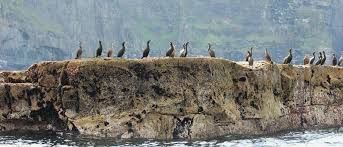
#4. What birds nest at the Cliffs of Moher? The answer is that there are twenty-nine varieties of birds. These include: the Puffins, the Razorbills, the Guillemots, the Fulmars, the Kittiwakes, the Herring Gulls, the Great Black-backed Gulls, the Shags, the Choughs, common breeding birds, the Skylarks, and the Wheatear/Twites.


#5. How many visitors do the Cliffs of Moher each year? The answer says that “in 2014, more than 1 million visitors came to these spectacular cliffs, which meant for the first time ever, the Cliffs of Moher overtook Dublin Zoo as Ireland’s second-most popular tourist attraction (the Guinness Storehouse is #1).” It goes on to say that in 2015, the number increased by over 15%.

There is no doubt about it. The Cliffs of Moher are now part of the tourist scene of Ireland and will be there to stay for some time. They are beautiful, cold in the off-season, but worth the trip even if you go just to say that you went. I do want to go back as I was a little under the weather when I was there and couldn’t do all that I wanted to do. Someday I will return.


Thursday, 26 May 2016

Old Jameson Distillery


Today, I am going to talk about the Old Jameson Distillery. Some people may think that I should have done this earlier when I was writing about other things in Dublin, but it really doesn’t matter about the order of these posts as I am writing about the place or event so that people can get a real idea of what it’s like over there.

The Old Jameson Distillery is situated in Dublin near Smithfield Square. It is the original location of the distillery and, before moving from Dublin, covered more than 5 acres of land. I read that it “was like a city within a city” because of the professions that were involved with the company. There were “a Smithy, Cooperage, saw mills, engineers, carpenters, painters and coppersmiths’ shops.” (Wikipedia) The amount of water that was required for the making of whiskey was a large amount. There were two wells on the property.


When you look at the trades that were involved with the distillery, you would sometimes wonder why. Perhaps it was found to me more inexpensive to make your own barrels for the aging of the whiskey. After all, if you pay another company to make the barrels for you, you also have to give them enough money so that they can show a profit and stay in business. But, if you have enough money to be able to have the space, purchase and store the raw materials needed, and pay the coopers and carpenters, then you might want to think twice about contracting the work out. After all, you want to have the highest quality work for your product. There may have also been the possibility that the amount of barrels required by the company was too much for smaller business to handle along with the work from other companies.

The Old Jameson Distillery got to the point where there was no room left to grow in the original location. After all, in 1966, Jameson merged with The Cork Distillery Company and John Power and Son to form the Irish Distillers Group. The move brought three rivals under one umbrella. The distillery was the last distillery to close in 1971.

What happened was that the distillery reopened in a new location, the New Midleton Distillery in Cork. Most of the buildings in the old location were dismantled with the main building being kept as offices. Sometime during the 1990s there was a fire which lead to the building becoming run down. A decision was made about 15 years ago to upgrade the building and give it new life. Since completion, it has apartments, shops, restaurants, and, apparently, has a hotel. There is also a visitors’ center that describes how whiskey is made and offers samples.


John Jameson made a sound financial move when he moved from Scotland to Dublin and began to work for Bow Street Distillery the late 1790s.