Sunday, 17 July 2016

Why I Work on My Family History

I have been working on my family history since January of 2011. I had retired from the military in the previous September, and finally got to the point that I had the energy to start working on it. Backing up a bit, I had an interview with Veterans Affairs Canada in late 2010 and the interviewer asked me some questions, then insisted that I stay home on a back to work program to recover from stress. It took me to the end of January to start.

When I first started, I didn’t know very much about how to research my family. I knew that I needed help learning what to do, so I joined a couple of family history groups, the Upper Ottawa Valley Genealogy Group in Pembroke, the British Isles Family History Society of Greater Ottawa, and the Ottawa Branch of the Ontario Genealogical Society. I joined the group in Pembroke so that I could develop contacts in the local area so that I could get next to immediate assistance with how to research. The BIFHSGO was an idea to join regarding British research, and the OGS, regarding Canadian research. I have learned a great deal from all three groups and am maintaining my membership as, eventually, I will be back in Ontario.

Another thing that I like to do to increase my knowledge about the researching end of things is that I love to go to family history conferences. For the first couple of years, I was able to go to one almost every month from late March/early April until September. I hope to, someday, go to one in England called “Who do you think you are? Live.” It is a huge conference that is now held in Birmingham. I use all types of conferences as education to develop the knowledge for my own family history and to help others.

You can learn a lot about your family if you can find the records. Sometimes the Spirit will influence you to do something that you don’t normally do. I have been influenced by the Spirit to google names of some of my ancestors. It is amazing what can be found this way. 

Because I did the research of many of my ancestors, I have been able to submit their names for temple work. I was able to be present when John’s baptism and the laying on of hands for the gift of the Holy Ghost was done. I had a chance to talk with the young man who stood as proxy for my grandfather's brother, John, for the laying on of hands and I told him a little about John. I didn’t know at the time, but that same young man is my eighth cousin.

When a Ron who was involved with family history moved away, he told Joyce to ask me to help her with her family history. When I was starting to resolve a problem that he should have looked after, I discovered that Joyce is related to me albeit very distantly. It made a huge difference for me as I thought that I did not have any family in the upper Ottawa Valley area. I had already learned about the family connections not far from Ottawa. 

Heavenly Father blessed me for my diligence in family history and helping others with it.

I can promise you that if you work on your family history, you will receive blessings. You will be led to the information that you need to complete temple work for these people. I have prayed to Heavenly Father to help me find certain information and, I have found that, if the time is right, you will find it.

I have also learned that these are not just names and place-names. The people whose names you find were living people. Without them, you would not be here. They made it possible for you to have a life here in Newfoundland. Yes, you may have problems of your own, but the problems may be there to help you to develop into the person that Heavenly Father wants you to be. Your ancestors were chosen by Heavenly Father with extreme care. He knows you better than you know yourself. Your ancestors have given you the physical traits that you need for your life. They did their best for you and all of their descendants. They may have slipped up, but we all know that no one in this life is perfect.

About a month and a half ago, there was a trip to the Halifax Temple. My husband and I did not go on that particular trip as we had a wedding in Ontario to go to and went to the Toronto Temple while we were there. During our visit to the Temple, we were able to seal fourteen couples for time and all eternity, ten sons and eighteen daughters to their parents. This was the first time that we have been able to do sealings as we had to wait for some of the ordinances to be completed. This does not entail just my side of the family. It was almost equally divided between Gordon’s and my families.

I came to the realization a couple of years ago that these people are waiting for us to do the temple work for them. We cannot do the work for our family unless we know who our family members are. And, when we do the work, they are very excited about it. Some of them have been waiting for hundreds of years. When I did the work for my grandfather’s sister, she was so excited that her emotions almost overcame me and I almost could not finish what I needed to do. I had to ask her to back off a bit so that I could complete it. She did and I finished it.

I do not have things like this happen all the time when I go to the Temple. However, I can say that I am happy for my ancestors whose work that I completed and know that I will see them on the other side when I get there. Because there is so much work to be done in my family and because I and my son, Stephen, are the only active members of the Church in at least one of my lines, I cannot do all the work myself. I came to the realization that I will always have more work to accomplish than I am capable of doing. So, the next best thing is to reserve the temple work and choose what I can get done, then share the rest with the Temple. This way, the work shared should be completed within two years.

So, you may possibly be thinking, “How can I have experiences like this?” I can give you an answer that you may not like. It is not called family history work and temple work for a reason. You will have to make a sacrifice if you are not interested in doing these things. You will have to sacrifice time and make the effort to work on your family history. For those of you in or close to a chapel of the Church of Jesus Christ of Latter Day Saints, there are people working in family history as consultants. 

One thing that you will find is that researching for ancestors may not be anywhere near as hard as it used to be. You will find that you may be able to do most of your research online. However, there will be times, when you will have to use the older methods such as sending to the Family History Library in Salt Lake City for microfilms and waiting for them to come in. You may find that you will still have to send letters but most of them can be sent by email. The recipients usually respond quickly. There are also paid websites that you can get free access to in your own homes. These include Ancestry, Find My Past, My Heritage, and one or two more. There are paid websites that you can access free of charge through the Family History Center which has a portal to about twelve or thirteen family history sites.

When you travel, you can visit places such as archives who have genealogical consultants who can give you personalized direction. They won’t do the research for you but they will suggest what you should do. I actually think that even though you can gather a lot from online websites, you should go to visit the places that your ancestors lived in, even if you don’t know the exact location. I went to Ireland in April on a family history trip that included some things for family members to do while we were researching. We only did research for four days, but we came away with information about how to continue our work. The rest of the time, we saw the land that our ancestors came from. We learned about the Great Famine and we saw some of the conditions of that time and of the time of troubles in Northern Ireland and saw some of the progression that our “cousins” across the water made over time. Every one of the researchers were of Irish descent along with some of the family members.

When I retired from the military, I did something that I had waited for over thirty years to do. I went and visited England. While I was there, I visited the farm that my fourth-great-grandparents, Joseph Armstrong and Mary Scott, owned in northern England. I felt so happy that I found it, I was crying. I almost felt like I had returned home, but this was only partly returned home as the other part was Ireland. I knew that I had to visit Ireland, too. Well, I did that with my brother in April. Two places that we visited was Galway City, which I strongly believe that our ancestors, John Robert Sanderson and Margaret Nesbitt, with their little family came through in 1830, and the other place was the harbour for Wexford City, which I believe our ancestor, John Jackman, came through in 1820. Nothing beats walking the land that your ancestors walked.

You can also involve your family with your research. I did a talk in Petawawa shortly before coming to Newfoundland about putting the fun into family history. I am going to give some of that now:
In the September 2014 issue of the Ensign, there is an article “Put the Family into Family History”. In this article, Sally Johnson Odekirk describes a number of ways to help your family become interested in family history. She had some of the same ideas that I would like to suggest.

You can have a competition with other families to see how many names that you can have prepared for temple work by the time the next temple trip happens.

You can have a competition with family members by giving each member that is old enough a different branch to work on to see how many names you can have prepared for the temple within a certain period of time.

You can assign each family member the name of an ancestor to see how much information that they can find within a certain period of time and have them introduce that ancestor at a family home evening.

Along with finding the information about the ancestor, find out what was happening in the world at that time. Was it during war time? If so, which war and what part did your ancestor play?

Along with the younger children, try doing some role playing about parts of the lives of some of your ancestors.

Take a family trip to a place where some of your ancestors lived. Walk around the community; take a tour of the local church that your ancestors would have attended; visit the cemetery that your ancestors are buried in. If you visit a cemetery, call ahead to find out what section, row and plot that your ancestors now reside in. It will make it easier to find them.

During family home evenings, tell the stories about your ancestors that you know. Your children want to know about them.

Plan or attend family reunions and find out what other members of the family know. They may not have all the correct facts, but they can give you some good leads.

If your parents, grandparents, and great-grandparents are still living, have them write their life histories. Have them write about the family members that they knew. Also, have them write out the stories that they were told about the family. If they are not willing to write them out, ask if you can record them telling you these things. If they don’t agree to the recordings, ask if you can write them down so that when they are gone, you can still tell the stories for them. Then when you get home, digitize these things and keep them for you and future generations.

Sort out your family pictures, get them digitized, and share them with your family and extended family.

Family history is not about just collection the names and the facts. It’s about identifying your ancestors, praying about them, getting to know who they were, doing their Temple work for them and teaching your descendants about them.

I personally have found over 7,000 people. I can’t wait to meet them and the rest that I find while here in this world. I know that Heavenly Father loves us and wants to bless us. We will have rich blessings if we help our ancestors by finding who they were and taking their names to the Temple. We will be blessed to be able to find the information necessary for this work if we will just try. Heavenly Father is waiting for us to do this sacred work. Our ancestors are waiting for us to do this sacred work. We have already been commanded to do this sacred work. I cannot force you to do it. All I can do is to try to encourage you to do it.

Friday, 15 July 2016

Ross Castle


Ross Castle sits in Killarney National Park on the edge of Lough Leane which is Killarney’s lower lake. It is believed that Ross Castle was built in the 15th century by O’Donoghue Mór and is the ancestral home of the O’Donoghue Clan. Ownership changed hands during the Second Desmond Rebellion to the MacCarthy Mór in the 1580s. The castle and its lands were leased to Sir Valentine Browne, whose descendants include the Earls of Kenmare.


During the Irish Confederate War, the castle was one of the last to be surrendered to Oliver Cromwell’s Roundheads. There was a prophecy that the castle could not be taken until a warship could sail on the lake. Well, it was believed that it would never happen, but it did. General Ludlow accepted the surrender of the castle.


After the wars were over, the Brownes were able to prove that the heir was too young to participate in the rebellion and the castle and land was returned to them. One hundred years later saw a mansion built on the land near the castle, but also saw the exile of the Brownes due to a relationship that was too close to James II. The castle then became a military barracks and continued with that purpose until the 19th century. The Brownes returned to the area, but did not return to the castle, instead building Kenmare House in Killarney.


There is still a legend that “O'Donoghue leaped or was sucked out of the window of the grand chamber at the top of the castle and disappeared into the waters of the lake along with his horse, his table and his library. It is said that O'Donoghue now lives in a great palace at the bottom of the lake where he keeps a close eye on everything that he sees.” (Wikipedia) If this is so, he must be amazed at the change in clothing over the years, and the change in customs, habits, and technology.


Castle Ross was built to be a defensive structure, to protect the people in the area in time of need, and to assure the people that they will be protected. The castle has an iron gate that can be lowered while the front door is closed, the exterior doors were two ply with the layers at 90° angles to each other. There was at least one murder hole, and slits for arrows, and later guns. There are other defensive measures. The tower was five stories high and can be quite formidable to the attacker.


Castle Ross is now run by the Office of Public Works and run tours seasonally. Tours for more than 10 people have to be prebooked. The following is the contact information for Ross Castle:


Telephone No: +353 64 6635851 Fax: +353 64 6635852 Email: rosscastle@opw.ie


Thursday, 14 July 2016

A Ride in the Park


What would you consider to be an enjoyable ride? Would it be in a high speed, high performance car? Or, would you consider another type of ride? Would you consider the type of transportation that was in the British Isles prior to a hundred years ago?

Close your eyes and let your imagination take over. You are about to take a short trip with your significant other and you need to decide on the type of transportation that you are going to use. Are you going to use horses to race each other and get a “thrill” of a lifetime? Or, do you want something that is more romantic? Will you need transportation for just the two of you? Or, will there be a group of people going with you?


During the nineteenth century, there was a form of transportation used in Dublin that could be used with the help of one horse. It was a two-wheeled vehicle called a jaunting car and was designed to have a driver for the horse and to carry two or four people at a time. Samuel Coleridge made arrangements for one for a tour of Ireland with William Wordsworth, who named himself as driver, and Wordsworth’s sister, Dorothy. Apparently, Wordsworth did not do so well as a driver.

There were also two types of jaunting cars, outside jaunting cars and inside jaunting cars. If you are in an outside jaunting car, you look out, across the wheels at the scenery. If you are in an inside jaunting car, you are sitting on the benches facing inwards towards your companions. Our group used about three jaunting cars and they were all inside jaunting cars.


Jaunting cars today are designed to carry between ten and twelve passengers and have four wheels instead of two wheels. They are still pulled by one horse and are used mostly by tourists. The companies in Killarney take their passengers out to Ross Castle in Killarney National Park. They give their passengers enough time to visit the castle and the castle grounds before taking them back to their hotels. Almost all of the jaunting cars in Killarney have overhead protection from rain if there is no wind. The car that I was in also had plastic walls that gives better protection in the rain.

On the way out to Ross Castle, I rode in the back. It gave me a chance to experience what the ride was like in the back. Seriously, though, I wanted to ride up front, but I know how selfish I can be, so I chose to sit in the back so that someone else could have the privilege. The person who sat with the driver decided that she felt that the wind was too cold for her and wanted to go into the back with everyone else. I jumped at the chance to ride in the front and I don’t regret doing it. I had a chance to talk with the driver one-on-one and actually had a chance to drive the horse for about ten minutes.


We arrived back at our hotel with time enough for a quick break, and then we were off to our next adventure. I would suggest that anyone who visits Ireland and doesn’t go on a jaunting ride when given the chance, is not experiencing all that Ireland has to offer. I enjoyed the ride and the chance to actually drive the horse. If I come across the chance to do it again, I will not be missing the chance to repeat my experience.


Wednesday, 13 July 2016

Gaelic Roots, The Show

While we were on our way to Killarney, our bus driver told us about a show that had been running for about two weeks and would be continuing through the summer until the middle of October. The name of the show was Gaelic Roots, The Show.

This show is being held at the Killarney Avenue Hotel which is across the square from the Killarney Plaza Hotel. So it was a short walk for me to go to the show. There was a small number of people from our tour that opted to go that night. Those people who heard about it from us and wanted to go were out of luck as it was a night off for the cast on our second night in Killarney. As soon as I heard about it, I wanted to see it and not seeing it was not an option. So, I made sure that I was there in plenty of time to get in.

I arrived about 30 minutes early so that I could get a good seat. I first thought that the seats near the front would give me the view that I was looking for. After about ten or fifteen minutes, and with the help of other people sitting in front of me, I realized that I might not have picked the best seat to sit in. I looked further back and realized that some of the chairs were set up on risers. I headed back to get to the front of the last riser, and tripped and fell almost flat on my face at the first riser. I did a bit of damage to my ankle, but I knew that it would heal. There was not severe damage done except to my pride.

I found the seat that I wanted and had a very clear view of the show. It was a mixer of song, music, and dancing and you could tell that the cast was having fun with it.

The cast is a renown group of international Irish performers. The O’Neill Sisters were the singers and came in from New York to do this show for the summer. It is something that they believe in and they were happy to do so. Tomas O Se is a Kerry Minor football star and a world class Irish dancer who has danced with Riverdance. Kelly McDonnell is a world class Irish dancer who has danced with Michael Flatley. Tony Flaherty is a world renowned musician and plays with The Gaelic Roots Band. They cover a lot of instruments including the flute, the bodrhan, the fiddle, and more. There are also the Gaelic Roots Troop Dancers who have danced with Riverdance and other productions.

When the performance starts, it’s as if you are going back through the mists of time. The music is not just from the modern era, but also from further back in time. I think that maybe, “Danny Boy” is the only one that I have previous heard. I don’t know about the rest of the audience, but I was mesmerized for the entire performance. The show lasts for two hours and there is a fifteen-minute break about half way through. It gives you a chance to stretch your legs and come back to earth before continuing on in the world of fantasy. The cast received a well-deserved standing ovation.
Going back to the hotel, I chanced on some of my friends from the tour. One of them decided that I could not do the short trip back to our hotel by myself, but needed someone with me. I really didn’t but I decided to humour her.

Would I go to Gaelic Roots, The Show again? With a resounding yes, I would go again if I have the chance. I love the Irish music and dancing and don’t have much chance to see the dancing. 

Tuesday, 12 July 2016

The Dingle Peninsula


On the southern part of the western coast of Ireland is the Dingle Peninsula which is situated in County Kerry. It has a number of communities and fabulous scenery. There are also golf courses, and other tourist attractions. There is a village there that goes by the name of Dingle and is not far from the beach that we stopped at. The Dingle Peninsula was made famous by the movie “Ryan’s Daughter”.


Dingle has a number of small restaurants, but all of our group seemed to head for one in particular. It is right across from the bus park, and is quite handy to a small shopping district. I also think that the fact that the bus driver recommended this particular restaurant also helped.


We had enough time to have a lunch in a crowded restaurant that was also a favourite with the local people and to wander up the street. The name is Harrington’s Family Restaurant and their fish and chips are enjoyable.

Once we finished our lunch, my brother and I decided to head up the street to see what was there. We stopped into a couple of the shops. One of the shops was an outlet for Blarney Woolen factory. Once I had a look around and saw the prices of the merchandise, I realized that this was not a shop for someone on a relatively tight budget. So, I continued on my way.


Further up the street, I found a shop that seemed to belong to the Murphy family. They were right beside Murphy’s Pub, and had a sign over the door for Murphy’s B&B. I found the type of shop that I was looking for, souvenirs. I was able to get a number of small gifts, filling the bill for all of my seven grandchildren, my mother-in-law, and my sons. I also found something that I was looking for, a bodrhan. They had two sizes of bodrhans, but I chose the bigger one of the two. When I went to pay for my purchases, it turned out that everything was at half price. As this was before the yearly tourist season began, I believe that they were trying to move out last year’s stock before the new stock arrived. That’s alright, I can handle getting things at sale price.

The Dingle Peninsula, as I have said earlier, does have some tourist spots because of the movie, but I would imagine that a good portion of the income of the area is from farming. The fields were already turning green and the farmers were already spending time in the fields.


I think that it would be nice to return to the area to spend a couple of days to relax and to regroup while on a trip. It seems to be a relatively quiet and slow-paced area, something just to calm the frazzled nerves of touring.


Friday, 8 July 2016

A Medieval Dinner


How many people have been to Medieval Times for a dinner show? There is only one place in Canada that you can go to Medieval Times and that is at Exhibition Place in Toronto. However, there are 8 more places in the United States: Kissimmee, Florida; Buena Park, California; Lyndhurst, New Jersey; Schaumburg, Illinois; Dallas, Texas; Myrtle Beach, South Carolina; Hanover, Maryland; and Lawrenceville, Georgia. This dinner show features jousting, falconry, and a showing of medieval arms. My husband and sons took me for my birthday in 1997 and I enjoyed every minute of it.
I had been thinking for about the last six months that it was time to go again. After all, it has been almost 20 years since we went and I enjoy watching things like this. I especially enjoy it if I can be at a live performance. Imagine my surprise when I read the itinerary to find that we would be going to a medieval dinner in a medieval castle while we were in Ireland.


The castle in question was the Bunratty Castle in County Clare. There are other castles in Ireland that hold medieval dinners but we only went to this one. I don’t know how the others compare to this one. Maybe some day, I will have the chance to visit all of the Irish medieval dinners and write a blog on it.


When we arrived at the castle, we were piped into the Great Hall to be greeted, given the bread of welcome, and a cup of mead (fruit punch for those that don’t drink alcohol). There was entertainment provided in the form of a harpist, a violinist, and singers. We socialized and the “Earl of Thomond” for the evening and his Lady were chosen.


Once the Earl and his Lady were conducted to another room to learn of their duties, we were then led to the dining room. There we sat on benches at tables which designs would have been used during the medieval period. The Earl and his Lady were piped in to be seated at the head table. All of the announcements were done by the Earl’s butler. You have to remember that when you go, everything is meant to give you a fun look at the medieval time period. As an example, every dinner will have a “scoundrel” who gets thrown into the dungeon and has to do something chosen by the Earl to be able to get out of the dungeon. In our case, Brian Anderson was the scoundrel and was supposed to sing a song. I don’t know if he actually did as I know that he doesn’t like to sing.

When eating dinner, you are provided with only a knife. Our ancestors from that time period did not have such things as forks for eating. A fork was considered a tool for serving food. They had wooden spoons that they would use for soup. They would drink the soup from the bowl as from a cup. The spoon was to assist with the chunkier parts of the soup such as bits of meat and vegetables. Everyone from that time period carried knives. They were used for cutting rope, meat, etc, defending yourself from mad dogs, and so on. When our ancestors visited for a meal, they provided their own knives, but the host would provide the spoon when necessary.

The dinner that we had started off with some spiced parsnip soup which was quite nice. This was followed by spare ribs and honey and whiskey sauce. I don’t usually care for spare ribs, but I was hungry and the meat was tender and flavourful. The main course was pan smeared supreme of chicken, fresh garden vegetables, baby roast potatoes, and Bordelaise sauce. I tasted the chicken but could not eat much of it even though it was delicious. I had some of the vegetables which were nicely good, and I did enjoy a couple of the roast potatoes. The final course was Bramley apple and cinnamon crunch with Chantilly cream. This was a nice finish to an extremely delicious meal. Although I was not able to eat everything, I did enjoy what I was able to eat.

The staff gave us some fine renderings of medieval Irish music. There were some songs that told serious stories and others that were fun songs. I do have to say that I enjoyed it as much as I enjoyed Medieval Times in Toronto 20 years ago. Would I do it again? Yes, I would. Do I recommend others to go? Yes, I do recommend it.


I did find a review that said that it was crowded seating with not much room to move about. I suppose that this is true to a certain extent, but if you want to get the Irish experience, sometimes you need to take a bit of discomfort to understand how your Irish ancestors lived.

Life was not as comfortable for them as it is for us today. Those of us that think that they have it hard would be shocked at what their ancestors took for granted. They were happy to have a roof over their heads, a bed to sleep in, food to eat, and clothes to wear. They had to work hard to provide for themselves. There were times when the poor of Ireland of long ago actually had better conditions than the third or fourth son of a nobleman. This son would not be able to marry until he was able to support his wife or have his eldest brother guarantee that he would be able to live with his eldest brother and help to keep the family home safe and in working condition. Many younger sons either went into service as knights. They just could not afford to have a wife and family for many years if at all.


Just think about your ancestors when you think about your problems. Think about how much harder they had to work to get maybe a quarter of the way in society that you have the privilege of being in. Would you like to go back and take their place so that they can experience your life? Count your blessings that you live in the 21st century and not the 12th century.


Tuesday, 5 July 2016

The Cliffs of Moher


There once was an old fort called Moher which stood on Hag’s Head. It was the southernmost point of a range of cliffs that border on the Atlantic Ocean in the Buren Region of County Clare. The fort has now given its name to cliffs on which it once stood. The fort itself was destroyed in 1808 and the materials from the fort were used for a telegraph tower. This tower was built as a lookout tower during the Napoleonic wars.

The Cliffs of Moher is the second most visited tourist site in Ireland after the Guiness museum in Dublin. For several years now, they have had over a million visitors a year. The scenery is astounding and inspiring. The visitor’s center was built to not interfere with the ecological imprint of the area. It was built into the hillside leading up to the cliffs and uses renewable sources of energy such as geothermal heating and cooling, solar panels, and grey water recycling systems. The cliffs have won at least one major award.


The visitor’s center has a number of displays set up as well as a number of vendors of souvenirs. I had no intention of purchasing anything there but caved in because it was late April and the winds were too cold for me to handle. I know have a toque and a pair of gloves from there. Visitors can also visit the cliffs at sea level as there are a number of boat cruises to do this.

As I did the research on the Cliffs, I found that after some reading, I recognized one of the pieces of scenery that were pictured. I believe that it was the shot that was taken while the filming of Harry Potter and the Half-Blood Prince. It wasn’t the only movie that had scenes shot there. The movies include Harry Potter and the Half-Blood Prince, the Princess Bride, Ryan’s Daughter, and the Mackintosh Man. There were also some scenes done for the television show “Father Ted”. There were also two music videos taped there, one by Maroon 5 and the other by Westlife.


One of websites listed the top five interesting facts about the Cliffs of Moher.

#1. How old are the Cliffs of Moher? The answer given is 320 million years old. It goes on to state that the rocks are sandstone, siltston, and shale.

#2. How high are the Cliffs of Moher? The answer given is “702 feet (214 meters) high and span across eight miles or 12.8 kilometers along the Wild Atlantic Way. The highest point is at Knockarden, near O’Brien’s Tower, which was built by Cornelius O’Brien in 1835.” (http://www.cliffs-of-moher-cruises.com/news/top-5-interesting-facts-about-the-cliffs-of-moher/). The article goes on to say that they are not the highest cliffs in Ireland but they are the steepest.

#3. The Cliffs of Moher are in the movies as I mentioned earlier.


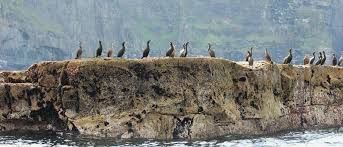
#4. What birds nest at the Cliffs of Moher? The answer is that there are twenty-nine varieties of birds. These include: the Puffins, the Razorbills, the Guillemots, the Fulmars, the Kittiwakes, the Herring Gulls, the Great Black-backed Gulls, the Shags, the Choughs, common breeding birds, the Skylarks, and the Wheatear/Twites.


#5. How many visitors do the Cliffs of Moher each year? The answer says that “in 2014, more than 1 million visitors came to these spectacular cliffs, which meant for the first time ever, the Cliffs of Moher overtook Dublin Zoo as Ireland’s second-most popular tourist attraction (the Guinness Storehouse is #1).” It goes on to say that in 2015, the number increased by over 15%.

There is no doubt about it. The Cliffs of Moher are now part of the tourist scene of Ireland and will be there to stay for some time. They are beautiful, cold in the off-season, but worth the trip even if you go just to say that you went. I do want to go back as I was a little under the weather when I was there and couldn’t do all that I wanted to do. Someday I will return.